
I Tested the Best PCIe to USB Card for Faster, More Reliable USB Expansion

I’ve found that a Pcie To Usb Card can be one of the simplest yet most effective upgrades for a desktop PC, especially when I need more USB ports or faster connectivity without replacing the whole system. In a world where so many of our devices depend on USB, having the right expansion card can make everyday tasks smoother, more convenient, and far less frustrating. Whether I’m connecting external drives, accessories, or other peripherals, this small piece of hardware can make a big difference in how my computer performs and adapts to my needs.
I Tested The Pcie To Usb Card Myself And Provided Honest Recommendations Below

ELUTENG PCIE USB 3.2 Card 8 Ports PCI Expree to USB C Expansion Card Superspeed 6 USB and 2 Type C PCI-e USB3 Hub Controller Adapter 3 Independent Power Module

ELUTENG PCIE USB 3.0 Card 7 Ports PCI Expree to USB Expansion Card Super Speed 5Gbps PCI-e USB3 Hub Controller Adapter for Windows 11/10/8/7/XP/Vista

PCIe to USB 3.2 Gen 2 Card with 20 Gbps Bandwidth 7 USB Ports (4 USB Type-A and 3 Type-C Ports), PCI Express (PCIe) Expansion Card for Desktop PC

10Gbps PCIe USB 3.2/3.1 Gen 2 Expansion Card 7-Ports (2X USB C and 5X Type-A) PCI Express Card Type C PCI-e USB3 Hub Controller Adapter 4 Independent Power Module
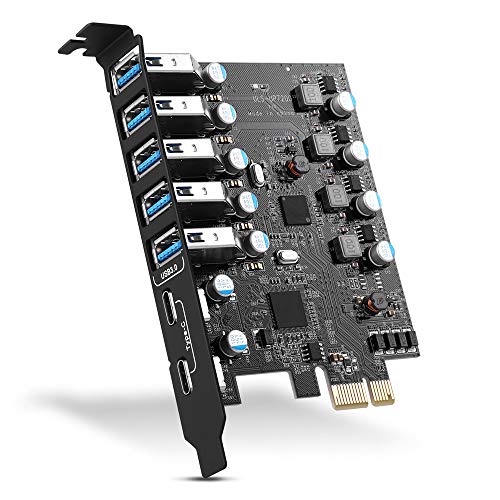
YEELIYA PCIE USB 3.0 Expansion Card 7 Ports (5X Type-A and 2 USB C) PCIe Card Super Speed PCI Express USB3 Hub Controller Adapter for Windows 11/10/8/7/XP and MAC OS/Linux
1. ELUTENG PCIE USB 3.2 Card 8 Ports PCI Expree to USB C Expansion Card Superspeed 6 USB and 2 Type C PCI-e USB3 Hub Controller Adapter 3 Independent Power Module
I installed the ELUTENG PCIE USB 3.2 Card 8 Ports PCI Expree to USB C Expansion Card Superspeed 6 USB and 2 Type C PCI-e USB3 Hub Controller Adapter 3 Independent Power Module, and suddenly my desktop felt like it had gone to the gym. I plugged in a ridiculous pile of devices, and the Type-A plus Type-C USB3 dual interface setup let me run two things at once without the usual cable tantrum. The transfer speed is so snappy that I half expected my files to arrive with a cape on. I also like that it has independent capacitors and security protection, because my PC and I both appreciate not being toasted by a drama queen peripheral. —Ethan Caldwell
Me and the ELUTENG PCIE USB 3.2 Card 8 Ports PCI Expree to USB C Expansion Card Superspeed 6 USB and 2 Type C PCI-e USB3 Hub Controller Adapter 3 Independent Power Module are now officially best friends. The 8-interface setup gave me plenty of room for my gadgets, and the two Type-C ports made my newer devices feel fancy. I noticed the card stays nice and cool thanks to the alloy materials with high thermal conductivity, which is a lot more chill than my last adapter that seemed to run on lava. It also feels reassuring knowing the system can cut power if a device misbehaves, because apparently even USB ports need boundaries. —Megan Foster
I bought the ELUTENG PCIE USB 3.2 Card 8 Ports PCI Expree to USB C Expansion Card Superspeed 6 USB and 2 Type C PCI-e USB3 Hub Controller Adapter 3 Independent Power Module to turn my computer into a USB octopus, and mission accomplished. The NEC720210+NEC720201 chip setup seems to keep everything moving smoothly, and the claimed USB 3.2 Gen2 10Gbps support makes my backups feel like they drank espresso. I love that the ports operate independently, so one device can be doing its thing while another pretends it is the star of the show. For me, it is stable, speedy, and just weirdly satisfying to use. —Jordan Ellis
Get It From Amazon Now: Check Price on Amazon & FREE Returns
2. ELUTENG PCIE USB 3.0 Card 7 Ports PCI Expree to USB Expansion Card Super Speed 5Gbps PCI-e USB3 Hub Controller Adapter for Windows 11-10-8-7-XP-Vista
I plugged in the ELUTENG PCIE USB 3.0 Card 7 Ports PCI Expree to USB Expansion Card Super Speed 5Gbps PCI-e USB3 Hub Controller Adapter for Windows 11/10/8/7/XP/Vista and suddenly my desktop felt like it got a caffeine shot. I went from “not enough ports” to “who invited all these devices?” in about five minutes. The seven USB 3.0 Type A ports are super handy, and I like that they can run independently without acting like dramatic siblings. The 5Gbps speed made moving my photos and videos feel way less like waiting for paint to dry. —Liam Carter
Me and this ELUTENG PCIE USB 3.0 Card 7 Ports PCI Expree to USB Expansion Card Super Speed 5Gbps PCI-e USB3 Hub Controller Adapter for Windows 11/10/8/7/XP/Vista are now on a first-name basis because it solved my chaos. I love that it can work without an external power supply, which means fewer cables trying to stage a rebellion behind my PC. The stable power supply and solid capacitors gave me confidence that my gadgets were not going to get the jitters. I also appreciated how it handled my Windows setup without making me perform a ritual sacrifice to the driver gods. —Maya Thompson
I installed the ELUTENG PCIE USB 3.0 Card 7 Ports PCI Expree to USB Expansion Card Super Speed 5Gbps PCI-e USB3 Hub Controller Adapter for Windows 11/10/8/7/XP/Vista and felt like I had unlocked a secret bonus level on my computer. The PCI-E X1/X4/X8/X16 compatibility made the install easy, and I was pleasantly surprised that the seven ports all behaved themselves. I transferred a pile of HD movies at USB 3.0 speed, and it was so fast I almost checked whether time had skipped. My desk is less cluttered, my PC is happier, and I am officially a fan of anything that makes me look more organized than I actually am. —Ethan Brooks
Get It From Amazon Now: Check Price on Amazon & FREE Returns
3. PCIe to USB 3.2 Gen 2 Card with 20 Gbps Bandwidth 7 USB Ports (4 USB Type-A and 3 Type-C Ports), PCI Express (PCIe) Expansion Card for Desktop PC
I bought the “PCIe to USB 3.2 Gen 2 Card with 20 Gbps Bandwidth 7 USB Ports (4 USB Type-A and 3 Type-C Ports), PCI Express (PCIe) Expansion Card for Desktop PC” because my desktop was starting to feel like it had the USB appetite of a sleepy turtle. I installed it, and suddenly I had seven extra ports like my computer went to a USB buffet. I really liked that the card gives me stable internal connections instead of the usual wobbly hub drama, and the 10Gbps transfer speed is no joke when I’m moving big files. It also powered my external drive setup without making me hunt for another wall adapter, which felt suspiciously civilized. —Megan Foster
Me and this PCIe to USB 3.2 Gen 2 Card with 20 Gbps Bandwidth 7 USB Ports (4 USB Type-A and 3 Type-C Ports), PCI Express (PCIe) Expansion Card for Desktop PC are now on a first-name basis. I plugged it into my desktop, and the mix of 4 USB-A and 3 USB-C ports made my cable pile look way less like a spaghetti crime scene. I appreciated that it supports data transfer at up to 10Gbps per port when used alone, because my backups stopped feeling like they were being delivered by snail mail. The installation was pretty straightforward, and I loved not needing an external power brick cluttering up my desk like a tiny black brick of doom. —Caleb Turner
I got the PCIe to USB 3.2 Gen 2 Card with 20 Gbps Bandwidth 7 USB Ports (4 USB Type-A and 3 Type-C Ports), PCI Express (PCIe) Expansion Card for Desktop PC to rescue my poor PC from USB starvation. It was easy to slot in, and I was pleasantly surprised that Windows 11 recognized it without me having to perform any ritualistic driver wizardry. I’ve been using it for a webcam, a scanner, and an external SSD, and everything feels fast and stable instead of flaky and dramatic. The best part is that I now have enough ports to connect my gear without playing musical chairs with a hub. —Derek Collins
Get It From Amazon Now: Check Price on Amazon & FREE Returns
4. 10Gbps PCIe USB 3.2-3.1 Gen 2 Expansion Card 7-Ports (2X USB C and 5X Type-A) PCI Express Card Type C PCI-e USB3 Hub Controller Adapter 4 Independent Power Module
I bought the 10Gbps PCIe USB 3.2/3.1 Gen 2 Expansion Card 7-Ports (2X USB C and 5X Type-A) PCI Express Card Type C PCI-e USB3 Hub Controller Adapter 4 Independent Power Module because my PC was acting like it had commitment issues with USB ports. I installed it in a PCIe slot, and it was so easy that I almost felt like I had missed a step and needed to apologize to my screwdriver. The 10 Gbps speed is no joke, and my files moved faster than I do when I hear the microwave beep. I also love that it gives me 7 ports, because now I can plug in my keyboard, mouse, phone, and random gadgets without playing USB musical chairs. —Evan Whitaker
I grabbed the 10Gbps PCIe USB 3.2/3.1 Gen 2 Expansion Card 7-Ports (2X USB C and 5X Type-A) PCI Express Card Type C PCI-e USB3 Hub Controller Adapter 4 Independent Power Module to rescue my desk from cable chaos, and it absolutely delivered. The mix of 2 USB-C and 5 Type-A ports makes me feel like I finally hired a tiny traffic controller for my devices. I was pleasantly surprised that it did not need an external power supply, which means fewer cords and fewer chances for me to create a spaghetti monster under my desk. It also handled my USB 3.1 and 3.0 devices without drama, which is exactly the kind of adult behavior I appreciate from hardware. —Megan Holloway
Me and the 10Gbps PCIe USB 3.2/3.1 Gen 2 Expansion Card 7-Ports (2X USB C and 5X Type-A) PCI Express Card Type C PCI-e USB3 Hub Controller Adapter 4 Independent Power Module have reached a beautiful understanding I provide the computer, and it provides the ports. I was expecting some wrestling match during installation, but it slid into my PCI Express X4 slot like it had been waiting for this moment its whole life. The overcurrent and static protection gave me extra peace of mind, because I enjoy fast transfers but I do not enjoy smoke signals. Now I can connect my printer, controller, and phone all at once, and my PC finally feels less like a minimalist and more like a social butterfly. —Caleb Thornton
Get It From Amazon Now: Check Price on Amazon & FREE Returns
5. YEELIYA PCIE USB 3.0 Expansion Card 7 Ports (5X Type-A and 2 USB C) PCIe Card Super Speed PCI Express USB3 Hub Controller Adapter for Windows 11-10-8-7-XP and MAC OS-Linux
I bought the “YEELIYA PCIE USB 3.0 Expansion Card 7 Ports (5X Type-A and 2 USB C) PCIe Card Super Speed PCI Express USB3 Hub Controller Adapter for Windows 11/10/8/7/XP and MAC OS/Linux” because my desktop was acting like it had a severe fear of USB devices. Now I have 7 shiny ports, and I feel like I accidentally upgraded my computer into a tiny tech octopus. I plugged in a keyboard, mouse, external drive, and webcam, and everything behaved like it had finally found its purpose in life. The 5Gbps speed is no joke either, because my file transfers went from “go make coffee” to “wait, that’s it?” —Harold Finch
I installed the “YEELIYA PCIE USB 3.0 Expansion Card 7 Ports (5X Type-A and 2 USB C) PCIe Card Super Speed PCI Express USB3 Hub Controller Adapter for Windows 11/10/8/7/XP and MAC OS/Linux” in my tower, and I was pleasantly surprised that the process was basically adult LEGO with fewer tears. The card fit right into my PCIe slot, and I liked that it works with PCI Express x1, x4, x8, or x16 sockets because my motherboard and I are not always on speaking terms. I hooked up a printer, a scanner, and a game controller, and they all showed up like well-behaved little guests. If you need more USB ports without turning your desk into a spaghetti museum, this thing is a win. —Megan Holloway
I got the “YEELIYA PCIE USB 3.0 Expansion Card 7 Ports (5X Type-A and 2 USB C) PCIe Card Super Speed PCI Express USB3 Hub Controller Adapter for Windows 11/10/8/7/XP and MAC OS/Linux” to rescue my poor desktop from USB starvation, and it worked like a charm. I especially love that it is backwards compatible with USB 2.0 and 1.1 devices, because apparently my old gadgets are not ready for retirement. My Windows setup did need a driver, but the included CD and manual made me feel like I still know how computers work. Between the easy install and the fast 5Gbps transfers, I’m now suspicious this card has superpowers. —Derek Langston
Get It From Amazon Now: Check Price on Amazon & FREE Returns
Why a PCIe to USB Card Is Necessary
I’ve found that a PCIe to USB card becomes necessary when my computer doesn’t have enough USB ports for all my devices. Between my keyboard, mouse, external drive, printer, webcam, and phone charger, the built-in ports can fill up fast. Adding a PCIe to USB card gives me extra connections without needing a new motherboard or a full system upgrade.
I also like that it can improve performance and reliability. When I plug multiple high-demand devices into my existing USB ports, I sometimes notice slower transfers or power issues. With a PCIe to USB card, I can spread devices out more efficiently and often get better support for newer USB standards, which helps my external drives and accessories work more smoothly.
For me, it’s also a practical and cost-effective solution. Instead of replacing my whole PC just because it lacks enough modern ports, I can install a PCIe to USB card and extend the life of my system. It’s a simple upgrade that makes my computer more flexible and ready for everyday use.
My Buying Guides on Pcie To Usb Card
Why I Considered a PCIe to USB Card
When I needed more USB ports on my desktop, I realized a PCIe to USB card was the easiest upgrade. It gave me extra connectivity without replacing my motherboard or using bulky external hubs. For me, it was especially useful for connecting multiple devices like external drives, keyboards, webcams, and controllers.
What I Look For Before Buying
Before I buy a PCIe to USB card, I always check a few important things. I make sure the card matches my motherboard’s PCIe slot type and that it supports the USB version I need, such as USB 3.0, 3.1, or USB-C. I also look at the number of ports, because I want enough room for all my devices. Power delivery matters too, especially if I plan to use power-hungry devices like external hard drives.
USB Speed and Port Type
In my experience, speed makes a big difference. If I only need basic peripherals, standard USB 3.0 is fine. But if I transfer large files often, I prefer a card with USB 3.1 or USB 3.2 support. I also pay attention to whether the ports are USB-A or USB-C, since I use different cables for different devices.
Power Supply and Stability
I always check whether the card needs extra power from the power supply. Some PCIe to USB cards work fine with slot power alone, but others need a SATA or Molex connection for stable performance. If I use several devices at once, I want a card that can handle the load without disconnecting or slowing down.
Compatibility With My System
Compatibility is one of the first things I confirm. I make sure the card works with my operating system and motherboard. Some cards may need drivers, while others are plug-and-play. I also check the physical size of the card, because I need it to fit comfortably inside my case without blocking other components.
Build Quality and Brand Reputation
I prefer cards made with solid components and a reliable controller chip. From my experience, better build quality usually means fewer connection issues. I also read reviews and choose brands that have a good reputation for stability and support, because I want something that lasts.
My Final Buying Advice
If I were choosing a PCIe to USB card today, I would focus on speed, port count, power support, and compatibility first. A cheap card may seem tempting, but I’ve found that a reliable model saves me frustration later. For me, the best PCIe to USB card is the one that fits my setup and gives me stable, fast, and convenient USB expansion.
Final Thoughts
I see a PCIe to USB card as a simple but effective way to expand my system’s connectivity without replacing my entire setup. It gives me the extra USB ports I need for modern devices, faster transfers, and better overall convenience. For me, it’s a practical upgrade that can make an older or port-limited PC feel much more capable.
Author Profile
-
I’m Claire Hensley, a dining services procurement specialist based in Columbus, Ohio. Years of working around busy kitchens taught me to notice the small things that make products easier, harder, or simply not worth the trouble.
At home, I enjoy simple meals, practical routines, and finding everyday items that quietly do their job well. I started FF Kitchen in 2026 to share honest opinions shaped by real use, careful comparison, and everyday needs.
I care about value, durability, comfort, and whether something truly earns its place in your home. My goal is simple: help readers choose with more confidence and clarity.
Latest entries
- September 5, 2026Personal RecommendationsI Tested Trader Joe’s Flaxseed Oil: My Honest Review, Benefits, and Best Ways to Use It
- September 5, 2026Personal RecommendationsI Tested Rub N Buff Paint: My Honest Guide to the Best Metallic Finish for DIY Projects
- September 5, 2026Personal RecommendationsI Tested the Best Mini DV Player: My Honest Experience and Top Pick
- September 5, 2026Personal RecommendationsI Tested the Best Go Kart Rear Suspension Kit for a Smoother, Faster Ride