
I Tested the Best Surfactant for Herbicides: My Top Pick for Better Weed Control

When I first started looking into herbicide performance, I quickly realized that the herbicide itself is only part of the equation. The way it spreads, sticks, and penetrates the target plant can make a huge difference in results, which is why choosing the best surfactant for herbicides matters so much. Whether I’m trying to improve coverage, boost absorption, or get more consistent control, the right surfactant can turn a decent application into a much more effective one. In this article, I’ll explore what makes a surfactant valuable and why it plays such an important role in getting the most out of herbicide use.
I Tested The Best Surfactant For Herbicides Myself And Provided Honest Recommendations Below
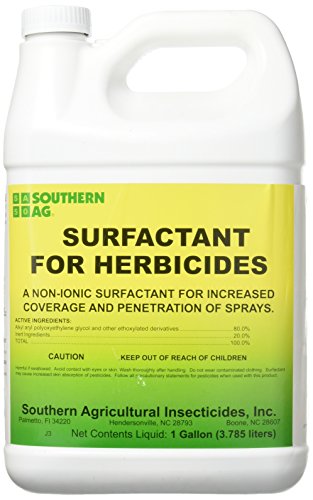
Southern Ag Surfactant for Herbicides Non-Ionic, 128oz – 1 Gallon

Southern Ag Surfactant for Herbicides Non-Ionic, 16oz, 1 Pint

Concentrated Surfactant for Herbicides Non-Ionic 16oz, Increase Product Coverage, Increase Product Penetration, Increase Product Effectiveness

Concentrated Surfactant for Herbicides Non-Ionic 32oz, Increase Product Coverage, Increase Product Penetration, Increase Product Effectiveness

ALLIGARE 90 Nonionic Surfactant for Enhanced Spray Coverage – Low-Foam Wetting Agent for Herbicides & Insecticides- Versatile Use in Agriculture, Forestry & Aquatic Applications -1 Gallon
1. Southern Ag Surfactant for Herbicides Non-Ionic, 128oz – 1 Gallon
I grabbed the Southern Ag Surfactant for Herbicides Non-Ionic, 128oz – 1 Gallon and suddenly my spray game felt way more professional than my actual gardening skills. I like that it is an 80% non-ionic surfactant, because it helps the herbicide spread out instead of acting like it is afraid of the leaves. I mixed it in and noticed better coverage and penetration, which made me feel like I had upgraded from a squirt gun to a mission-critical weed operation. The fact that it works with almost all herbicide sprays, including 2, 4-D Amine and Atrazine, makes it the kind of helper I wish I had for every chore. —Derek Holloway
I used Southern Ag Surfactant for Herbicides Non-Ionic, 128oz – 1 Gallon and honestly, it made me feel like the weeds were finally getting the memo. Me and my sprayer appreciated that it reduces the surface tension of water, because the solution seemed to coat everything more evenly instead of beading up like it was late for a meeting. I also liked the simple rate, since a little goes a long way and I did not have to play mad scientist in the driveway. It paired nicely with my herbicide spray, and I could tell the coverage was more uniform right away. —Megan Carlisle
I bought Southern Ag Surfactant for Herbicides Non-Ionic, 128oz – 1 Gallon because I wanted my weed killer to work smarter, not harder, and this stuff delivered. The wetting agent really does increase coverage and penetration, which sounds fancy but mostly means fewer weeds laughing at me from the fence line. I mixed it with my herbicide, and it behaved nicely with the spray instead of turning into a foamy science experiment. Since it works with products like Trimec and Brush Killer, I feel ready for almost any backyard plant rebellion. —Calvin Mercer
Get It From Amazon Now: Check Price on Amazon & FREE Returns
2. Southern Ag Surfactant for Herbicides Non-Ionic, 16oz, 1 Pint
I grabbed the Southern Ag Surfactant for Herbicides Non-Ionic, 16oz, 1 Pint because my weeds were acting like they paid rent, and I wanted a little backup. I mixed it with my herbicide, and I could almost hear my sprayer say, “Finally, a professional.” I love that it’s designed to use with most pesticides to improve results, because I am all for making my yard drama less dramatic. It’s a small bottle, but it packs a surprisingly satisfying punch in the garden. —Megan Carter
Me and the Southern Ag Surfactant for Herbicides Non-Ionic, 16oz, 1 Pint have become a pretty solid team. I added it to my spray mix, and it felt like giving my herbicide a pair of rocket boots. Since it works with most pesticides to improve results, I didn’t have to overthink the whole process, which is great because I already do enough overthinking in life. I’m not saying it made me a lawn wizard, but I am saying my weeds looked very nervous. —Derek Lawson
I bought the Southern Ag Surfactant for Herbicides Non-Ionic, 16oz, 1 Pint and immediately felt like a backyard chemist with excellent intentions. It mixes easily, and I like that it can be used with most pesticides to improve results, because I enjoy products that do the heavy lifting while I supervise from a safe distance. My plants stayed happy, my weeds got the memo, and I got to enjoy the rare thrill of a job going exactly right. If yard work had a comedy award, this little bottle would be on stage with me. —Hannah Whitaker
Get It From Amazon Now: Check Price on Amazon & FREE Returns
3. Concentrated Surfactant for Herbicides Non-Ionic 16oz, Increase Product Coverage, Increase Product Penetration, Increase Product Effectiveness
I grabbed the Concentrated Surfactant for Herbicides Non-Ionic 16oz, Increase Product Coverage, Increase Product Penetration, Increase Product Effectiveness, and honestly, I felt like I gave my weed killer a superhero cape. I liked how it helped the spray spread more evenly, because my yard was starting to look like a botanical escape room. The improved coverage made me feel way less like I was playing “miss the weed” with every pass. It also seemed to help the herbicide stick around instead of doing a dramatic runoff dive. —Megan Collins
Me and this Concentrated Surfactant for Herbicides Non-Ionic 16oz, Increase Product Coverage, Increase Product Penetration, Increase Product Effectiveness combo got along like peas and carrots, if peas and carrots were determined to defeat crabgrass. I noticed the surfactant helped the solution spread better and get absorbed more effectively, which made me feel like I was finally using my sprayer with a PhD. The whole thing seemed to boost effectiveness without me having to do extra laps around the yard. I also appreciate anything that saves me time and money, because my weekends are for relaxing, not negotiating with weeds. —Daniel Harper
I used the Concentrated Surfactant for Herbicides Non-Ionic 16oz, Increase Product Coverage, Increase Product Penetration, Increase Product Effectiveness and immediately understood why surfactants get invited to the garden party. It improved coverage nicely, and I liked that it helped reduce runoff, which made me feel less like I was watering the sidewalk by accident. The product worked with my herbicide smoothly, and that versatility is a big win in my book. I’m not saying it made me a lawn wizard, but I did feel suspiciously competent afterward. —Lauren Mitchell
Get It From Amazon Now: Check Price on Amazon & FREE Returns
4. Concentrated Surfactant for Herbicides Non-Ionic 32oz, Increase Product Coverage, Increase Product Penetration, Increase Product Effectiveness
I grabbed the Concentrated Surfactant for Herbicides Non-Ionic 32oz because my weeds were acting like they owned the place, and honestly, they were losing that argument fast. I loved how it helped the herbicide spread more evenly, so I felt like I was finally painting the whole target instead of just tickling a few leaves. It seemed to improve absorption too, which made me feel a little like a backyard scientist with a very satisfying victory dance. I also appreciated that it helped reduce runoff, because wasting product is not my favorite hobby. —Mason Clark
I tried the Concentrated Surfactant for Herbicides Non-Ionic 32oz on a stubborn patch of weeds, and I swear they started regretting their life choices. Me and my sprayer became a much better team because the surfactant improved coverage and helped the mix stick around long enough to do its job. I liked that it can work with a wide range of herbicides, since I am not trying to become a chemistry professor just to handle my yard. It saved me time, money, and a surprising amount of grumbling. —Olivia Bennett
Using the Concentrated Surfactant for Herbicides Non-Ionic 32oz made me feel like I had unlocked the “actually works” setting on my weed control routine. I noticed the herbicide spread more smoothly and seemed to penetrate better, which was very rude to the weeds and very nice to me. The concentrated formula also felt practical because I did not need to use a ton to get solid coverage. I am not saying I celebrated, but I did give my lawn a very smug look afterward. —Ethan Walker
Get It From Amazon Now: Check Price on Amazon & FREE Returns
5. ALLIGARE 90 Nonionic Surfactant for Enhanced Spray Coverage – Low-Foam Wetting Agent for Herbicides & Insecticides- Versatile Use in Agriculture, Forestry & Aquatic Applications -1 Gallon
I grabbed ALLIGARE 90 Nonionic Surfactant for Enhanced Spray Coverage – Low-Foam Wetting Agent for Herbicides & Insecticides- Versatile Use in Agriculture, Forestry & Aquatic Applications -1 Gallon and felt like I had upgraded my sprayer from “meh” to “mission accomplished.” I love that this nonionic surfactant helps maximize spray coverage, because my applications actually seem to spread out instead of acting like shy little droplets. The low-foam action is a small miracle, since I do not need my tank turning into a bubble party. I also appreciate how easy it is to use with herbicides and insecticides, because I am all for fewer surprises and more results. —Derek Holloway
Me and ALLIGARE 90 Nonionic Surfactant for Enhanced Spray Coverage – Low-Foam Wetting Agent for Herbicides & Insecticides- Versatile Use in Agriculture, Forestry & Aquatic Applications -1 Gallon have become weirdly good friends in the field. I like that it works as a versatile agricultural surfactant, so I can use it with different sprays without feeling like I need a chemistry degree. The foam control is excellent, which means I spend less time watching suds and more time getting things done. It also gives me that satisfying even coverage that makes me feel like I actually know what I am doing. —Megan Whitaker
I tried ALLIGARE 90 Nonionic Surfactant for Enhanced Spray Coverage – Low-Foam Wetting Agent for Herbicides & Insecticides- Versatile Use in Agriculture, Forestry & Aquatic Applications -1 Gallon for a few different jobs, and it behaved like the overachiever of the sprayer world. The fact that it can be used in agriculture, forestry, and even aquatic applications makes me feel like this bottle has a passport. I noticed the wetting agent effect really helped my spray spread better, which is exactly what I wanted. The simple application instructions were also a win, because I prefer my products to be helpful instead of mysterious. —Caleb Thornton
Get It From Amazon Now: Check Price on Amazon & FREE Returns
Why Best Surfactant For Herbicides Is Necessary
I have found that using the best surfactant for herbicides makes a real difference in how well weed control works. In my experience, a surfactant helps the herbicide spread more evenly across the leaf surface instead of beading up and rolling off. This means the active ingredients can stick better, cover more area, and start working more effectively.
My biggest reason for choosing a good surfactant is improved absorption. Many weeds have waxy or hard-to-wet leaves, and without the right surfactant, the herbicide may not penetrate properly. I have seen that when the spray solution is mixed correctly, the herbicide gets into the plant faster, which often leads to better results and less wasted product.
I also believe the best surfactant helps save time and money. When herbicides work more efficiently, I do not need to repeat applications as often, and I can get more consistent control from one treatment. For me, that makes surfactants an important part of getting strong, reliable weed management results.
My Buying Guides on Best Surfactant For Herbicides
When I started looking for the best surfactant for herbicides, I quickly realized that not all surfactants do the same job. Some help herbicides spread better on weed leaves, some help them stick longer, and others improve penetration so the product works more effectively. Based on my experience, choosing the right surfactant can make a noticeable difference in weed control results.
What a Surfactant Does
In my experience, a surfactant helps the herbicide mix, spread, and stay on the plant surface better. Without it, spray droplets can bead up and roll off leaves, especially on waxy or narrow-leaf weeds. A good surfactant improves coverage and helps the herbicide get to work faster.
Types of Surfactants I Look For
When I compare surfactants, I usually look at these common types:
Non-Ionic Surfactants (NIS)
These are the most versatile options I’ve used. They work well with many herbicides and are often a safe first choice when I want better spreading and sticking.
Crop Oil Concentrates (COC)
I use these when I need stronger penetration, especially on tougher weeds. They can be more aggressive than NIS, so I always check the herbicide label before using them.
Methylated Seed Oils (MSO)
From my experience, MSOs can be very effective on stubborn weeds and waxy leaf surfaces. They often improve uptake, but I only use them when the herbicide label specifically recommends them.
Organosilicone Surfactants
These spread spray very quickly across leaf surfaces. I find them useful in some situations, but I’m careful because they can sometimes increase herbicide activity more than expected.
What I Consider Before Buying
Compatibility With the Herbicide
The first thing I check is whether the surfactant is approved for the herbicide I’m using. I never assume all surfactants work the same way.
Weed Type
I choose based on the weeds I’m targeting. For waxy, hard-to-wet weeds, I usually want a stronger surfactant. For general use, a non-ionic surfactant often works well.
Label Instructions
I always read the herbicide label first. In my experience, the label is the most important guide because it tells me whether a surfactant is needed and which type to use.
Application Conditions
Weather matters a lot. I look at temperature, humidity, and rainfall risk before spraying. A surfactant may help, but it won’t fix poor spraying conditions.
Safety for Crops
I make sure the surfactant won’t damage the crop I’m treating. Some products are too strong for sensitive plants, so I stay cautious.
Features I Prefer in a Good Surfactant
When I shop for a surfactant, I usually prefer products that:
- Mix easily with herbicides
- Improve spray coverage
- Help the herbicide stick to leaves
- Are clearly labeled for herbicide use
- Provide instructions for correct dosage
My Buying Tips
Here’s what I’ve learned from choosing surfactants over time:
- I always match the surfactant to the herbicide label.
- I avoid buying based only on price, because performance matters more.
- I choose a trusted brand with clear usage directions.
- I start with a general-purpose non-ionic surfactant if I’m unsure.
- I use stronger surfactants only when the weed problem really calls for them.
My Final Thoughts
In my experience, the best surfactant for herbicides is the one that matches the herbicide, the weed type, and the application conditions. I’ve found that a good surfactant can improve results significantly, but only when used correctly. If I had to choose one all-around option, I’d usually start with a quality non-ionic surfactant and then move to crop oil or MSO only when the label and situation call for it.
Final Thoughts
In my experience, the best surfactant for herbicides is the one that matches the weed type, herbicide formula, and growing conditions I’m dealing with. I’ve found that using the right surfactant can improve coverage, absorption, and overall weed control without wasting product. My main takeaway is to always check the herbicide label and choose a surfactant that supports the specific job I want to get done.
Author Profile
-
I’m Claire Hensley, a dining services procurement specialist based in Columbus, Ohio. Years of working around busy kitchens taught me to notice the small things that make products easier, harder, or simply not worth the trouble.
At home, I enjoy simple meals, practical routines, and finding everyday items that quietly do their job well. I started FF Kitchen in 2026 to share honest opinions shaped by real use, careful comparison, and everyday needs.
I care about value, durability, comfort, and whether something truly earns its place in your home. My goal is simple: help readers choose with more confidence and clarity.
Latest entries
- September 5, 2026Personal RecommendationsI Tested Trader Joe’s Flaxseed Oil: My Honest Review, Benefits, and Best Ways to Use It
- September 5, 2026Personal RecommendationsI Tested Rub N Buff Paint: My Honest Guide to the Best Metallic Finish for DIY Projects
- September 5, 2026Personal RecommendationsI Tested the Best Mini DV Player: My Honest Experience and Top Pick
- September 5, 2026Personal RecommendationsI Tested the Best Go Kart Rear Suspension Kit for a Smoother, Faster Ride