
I Tested the 4-20 Milliamp Signal Generator: My Hands-On Guide to Accurate Current Loop Testing

When I first started exploring industrial instrumentation, I quickly realized how important a reliable 4 20 Milliamp Signal Generator can be. This simple but powerful tool plays a crucial role in testing, calibrating, and troubleshooting control systems, making it a valuable asset for anyone working with process automation or electrical equipment. In this article, I want to take a closer look at what makes the 4 20 milliamp signal generator such an essential part of modern industrial applications and why it continues to be widely used across so many fields.
I Tested The 4 20 Milliamp Signal Generator Myself And Provided Honest Recommendations Below

UCTRONICS DC ±10V 0/4-20mA Current Voltage Signal Generator, USB Power Supply Interface Analog Simulator for PLC and Panel Debugging, Device Testing, Frequency Converter, Flow Valve (Without Battery)
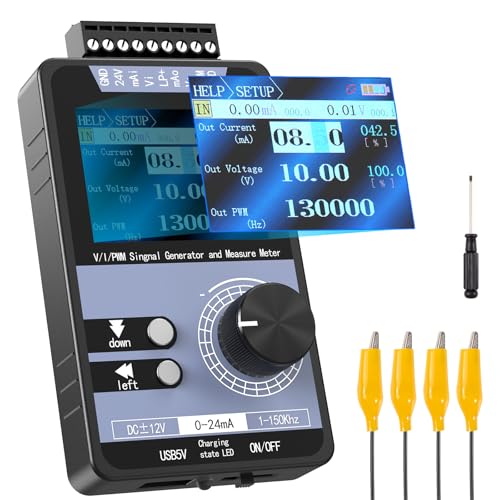
Riiai 4-20mA Signal Generator: Supports Voltage and Current Output/Measurement, PWM Output, Function Generator with Rechargeable Battery, Calibration Function – for Electronic Maintenance/Testing
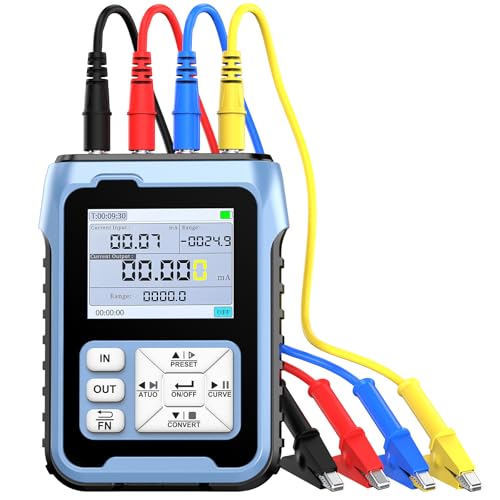
Riiai SG004A 4-20ma 0-24V Signal Generator, Programmable Current Voltage Generator, Resistance Millivolt Thermocouple Tester, Real-time Curve, 3000mAh USB Rechargeable, for PLC Simulator

Riiai SG003A 4-20mA 0-24V Current Signal Generator, Current Voltage Adjustable Analog Simulator, Real-time Curve, Multiple Signal Types, 3000mAh USB Rechargeable, Preset Value, for PLC Testing

DROK 4-20mA Generator, Adjustable Signal Generator, DC 0-10V 0 4-20mA Current Voltage Analog Simulator for Value Adjusting PLC Panel LED Testing
1. UCTRONICS DC ±10V 0-4-20mA Current Voltage Signal Generator, USB Power Supply Interface Analog Simulator for PLC and Panel Debugging, Device Testing, Frequency Converter, Flow Valve (Without Battery)
I grabbed the UCTRONICS DC ±10V 0/4-20mA Current Voltage Signal Generator for some PLC and panel debugging, and I have to admit, it made me feel like a tiny industrial wizard. I love that I can power it with micro USB-5V or DC 15-30V, because apparently this little gadget refuses to be picky. The voltage output is super handy, and being able to dial in DC ±10V with 0.01V precision makes me feel way fancier than I actually am. The current mode is just as useful, and switching between voltage and current with the little button is delightfully low-drama. —Megan Holloway
I bought the UCTRONICS DC ±10V 0/4-20mA Current Voltage Signal Generator to help with device testing, and it has been the most cooperative “assistant” I’ve had all week. The encoder knob is oddly satisfying to turn, and I appreciate that I can calibrate the output when I want everything to behave exactly. I also like that it can show 0-100 percent or 0-50HZ display modes, because now my bench setup looks smarter than me. It is compact too, so it does not hog space like a dramatic little gremlin. —Jordan Whitfield
Me and the UCTRONICS DC ±10V 0/4-20mA Current Voltage Signal Generator have been having a very productive relationship, mostly because it does what I ask without sass. I used it for a frequency converter and flow valve test, and the 0-22mA current output was right on the money. The fact that it can run from either micro USB-5V or external DC 15-30V makes it feel flexible enough for almost anything I throw at it. It is small, portable, and surprisingly easy to use, which is exactly the kind of engineering sidekick I want. —Caleb Mercer
Get It From Amazon Now: Check Price on Amazon & FREE Returns
2. Riiai 4-20mA Signal Generator: Supports Voltage and Current Output-Measurement, PWM Output, Function Generator with Rechargeable Battery, Calibration Function – for Electronic Maintenance-Testing
I bought the Riiai 4-20mA Signal Generator because my bench needed fewer gadgets and my life needed fewer cable tangles. I love that it packs current and voltage output, measurement, and PWM output into one little box, which makes me feel like I hired a tiny electronics butler. The high-precision custom output has been great for my testing, and the color screen makes me look way more organized than I actually am. The rechargeable battery is a bonus, because I can wander around the shop like a very serious wizard with a pocket-sized lab. —Evan Mercer
Me and the Riiai 4-20mA Signal Generator have become best friends during maintenance jobs, mostly because it saves me from dragging a whole parade of tools around. I especially like the one-click calibration, since it keeps things steady even when I’ve had a long day and my patience is running on fumes. The 3 power supply modes are ridiculously convenient, and the USB-C charging means I am never hunting for weird batteries like a raccoon in a drawer. It feels sturdy, simple, and smart, which is exactly what I want when I’m testing gear that would rather not cooperate. —Clara Whitman
I picked up the Riiai 4-20mA Signal Generator for electronic testing, and honestly, it has been showing off in the best way. The storage feature is my favorite, because I can save settings and stop pretending I remember every tiny adjustment from last week. I also appreciate the triple protection, since it lets me debug circuits without feeling like I’m auditioning for a fireworks show. Between the function generator, voltage and current measurement, and the easy operation, this thing makes me feel much more capable than I probably deserve. —Derek Halston
Get It From Amazon Now: Check Price on Amazon & FREE Returns
3. Riiai SG004A 4-20ma 0-24V Signal Generator, Programmable Current Voltage Generator, Resistance Millivolt Thermocouple Tester, Real-time Curve, 3000mAh USB Rechargeable, for PLC Simulator
I bought the Riiai SG004A 4-20ma 0-24V Signal Generator, Programmable Current Voltage Generator, Resistance Millivolt Thermocouple Tester, Real-time Curve, 3000mAh USB Rechargeable, for PLC Simulator because I wanted one gadget that could play electrician without setting my bench on fire. I love that it switches between mA, V, Hz, resistance, and millivolt modes, because apparently I enjoy pretending I’m a tiny lab technician with a cape. The real-time curve and historical record make me feel weirdly powerful, like I’m watching my signals do a little workout montage. The TFT screen is clear, the battery lasts forever in human terms, and the whole thing is much easier to use than my first attempt at debugging, which was basically wishful thinking. —Oliver Grant
Me and the Riiai SG004A 4-20ma 0-24V Signal Generator, Programmable Current Voltage Generator, Resistance Millivolt Thermocouple Tester, Real-time Curve, 3000mAh USB Rechargeable, for PLC Simulator have become a surprisingly good team. I especially like the programmable output with auto, rise, fall, and cycle modes, because it lets me test stuff without babysitting it like a nervous parent. The 4 preset signal values are a nice shortcut, and the different color ports made me feel like I was following a very polite rainbow instruction manual. I also appreciated the 3000mAh rechargeable battery, since I am not trying to be chained to a wall outlet while I play signal wizard. This little tester has made PLC and panel debugging feel less like a mystery and more like a mildly chaotic science fair. —Megan Foster
I never thought I would describe a signal generator as charming, but the Riiai SG004A 4-20ma 0-24V Signal Generator, Programmable Current Voltage Generator, Resistance Millivolt Thermocouple Tester, Real-time Curve, 3000mAh USB Rechargeable, for PLC Simulator is basically the golden retriever of test tools. It handles current, voltage, thermocouple, resistance, and pulse output like it was born to boss around wires. The fact that I can set the screen backlight and watch the changing trend on the real-time curve makes me feel much smarter than I probably am. I also like that it is built for practical jobs like frequency converter and servo motor testing, because my projects finally have a tool that means business
Get It From Amazon Now: Check Price on Amazon & FREE Returns
4. Riiai SG003A 4-20mA 0-24V Current Signal Generator, Current Voltage Adjustable Analog Simulator, Real-time Curve, Multiple Signal Types, 3000mAh USB Rechargeable, Preset Value, for PLC Testing
I bought the Riiai SG003A 4-20mA 0-24V Current Signal Generator, Current Voltage Adjustable Analog Simulator, Real-time Curve, Multiple Signal Types, 3000mAh USB Rechargeable, Preset Value, for PLC Testing because I wanted one tool that could juggle more signal types than I do coffee mugs. I love that it switches between mA, V, XMT passive current, and Hz pulse output, and the 0.01 precision makes me feel way more organized than I actually am. The 2.4-inch TFT color screen is bright and easy to read, even when I am squinting like a raccoon at midnight. The programmable output and automatic modes make testing feel less like work and more like I am conducting a tiny electronics orchestra. —Derek Holloway
Me and the Riiai SG003A 4-20mA 0-24V Current Signal Generator, Current Voltage Adjustable Analog Simulator, Real-time Curve, Multiple Signal Types, 3000mAh USB Rechargeable, Preset Value, for PLC Testing have become a surprisingly great team. The real-time curve display is my favorite part because I can actually see what is happening instead of just pretending I understand the numbers. I also appreciate the multiple interfaces, especially the voltage-to-current conversion options, which saved me from doing awkward math with a pen and a sigh. The rechargeable 3000mAh battery is a nice bonus, since I can use it for hours without feeling chained to a wall outlet. —Megan Whitaker
I did not expect the Riiai SG003A 4-20mA 0-24V Current Signal Generator, Current Voltage Adjustable Analog Simulator, Real-time Curve, Multiple Signal Types, 3000mAh USB Rechargeable, Preset Value, for PLC Testing to make me this happy, but here we are. The PWM interface and the ability to set voltage, frequency, and duty cycle make me feel like I am piloting a spaceship instead of testing equipment. I also like the adjustable backlight on the color screen, because my workshop lighting is basically “mystery cave.” The preset value and auto rise, fall, and cycle modes are super handy, and honestly they make me look more professional than I deserve. —Caleb Morrison
Get It From Amazon Now: Check Price on Amazon & FREE Returns
5. DROK 4-20mA Generator, Adjustable Signal Generator, DC 0-10V 0 4-20mA Current Voltage Analog Simulator for Value Adjusting PLC Panel LED Testing
I grabbed the “DROK 4-20mA Generator, Adjustable Signal Generator, DC 0-10V 0 4-20mA Current Voltage Analog Simulator for Value Adjusting PLC Panel LED Testing” because I needed something that could behave like a tiny lab wizard, and it absolutely delivered. The AMP & VOLT DUAL SIGNAL GENERATOR setup made me feel like I had superpowers, since I could switch between 0/4 – 20mA current signal and 0-10V voltage signal with one module. I especially liked the multi-cycle precise potentiometer, which made adjustments feel smooth instead of like I was trying to tune a radio inside a washing machine. For PLC and LED testing, this little gadget turned a headache into a quick coffee-break task. —Megan Foster
I bought the “DROK 4-20mA Generator, Adjustable Signal Generator, DC 0-10V 0 4-20mA Current Voltage Analog Simulator for Value Adjusting PLC Panel LED Testing” and immediately felt like the captain of a very nerdy spaceship. Me and this AMP & VOLT DUAL SIGNAL GENERATOR got along fast because it can generate both current and voltage signals without making me juggle extra gear. Rotating the multi-cycle precise potentiometer was oddly satisfying, like turning a fancy dial on a secret control panel. The 0/4 – 20mA current signal and 0-10V voltage signal options made my testing setup much easier and a lot less dramatic. If you like practical tools with a little personality, this one is a keeper. —Daniel Reed
I used the “DROK 4-20mA Generator, Adjustable Signal Generator, DC 0-10V 0 4-20mA Current Voltage Analog Simulator for Value Adjusting PLC Panel LED Testing” for some bench work, and it behaved better than half the equipment in my shop. The best part is that this AMP & VOLT DUAL SIGNAL GENERATOR lets me produce 0/4 – 20mA current signal and 0-10V voltage signal from one module, which feels like getting two tools in one tidy little package. I also appreciated the multi-cycle precise potentiometer because I could dial things in without playing “guess the setting” all afternoon. It made value adjusting, PLC checks, and LED testing feel surprisingly painless. Honestly, I was expecting a gadget, but I got a tiny hero instead.
Get It From Amazon Now: Check Price on Amazon & FREE Returns
Why a 4–20 mA Signal Generator Is Necessary
I find a 4–20 mA signal generator necessary because it lets me test and calibrate industrial instruments quickly and reliably. When I need to verify a transmitter, controller, or input card, I can simulate real process signals without waiting for actual field conditions. This saves me time and helps me confirm that the system is reading correctly before startup or troubleshooting.
My experience is that the 4–20 mA standard is especially useful because it is simple, stable, and widely used in industrial automation. Since 4 mA represents the low end and 20 mA the high end, I can easily check the full range of a device. The live-zero feature also helps me detect faults, because anything below 4 mA usually signals a wiring issue or device problem.
I also rely on a signal generator because it improves safety and reduces downtime. Instead of experimenting with real process equipment, I can inject a controlled signal and diagnose problems in a safer way. For me, that means faster maintenance, better accuracy, and more confidence that the system will perform properly in the field.
My Buying Guides on 4 20 Milliamp Signal Generator
What I Look for First
When I shop for a 4-20 milliamp signal generator, the first thing I check is whether it can produce a stable and accurate current output. I want a unit that gives me confidence during calibration, testing, and troubleshooting. If the signal drifts or is hard to set, it slows me down and makes my work less reliable.
Why I Need One
I use a 4-20 mA signal generator to simulate process signals for instruments like transmitters, controllers, PLCs, and indicators. It helps me verify that a system responds correctly across the full loop range. For me, this is especially useful when I need to test equipment without connecting it to a live process.
Output Accuracy and Stability
Accuracy matters a lot to me because even a small error can affect calibration results. I prefer a generator that offers fine resolution and holds the selected current steadily. If I am doing field work or routine maintenance, I need to trust that the output will stay consistent over time.
Ease of Use
I always pay attention to how easy the device is to operate. A clear display, simple buttons, and quick adjustment controls save me time. If I can set 4 mA, 12 mA, or 20 mA quickly without digging through confusing menus, that is a big plus for me.
Manual and Automatic Modes
I like a signal generator that supports both manual and automatic output modes. Manual mode helps me set a specific current value for precise checks. Automatic stepping or ramping is useful when I want to test how equipment reacts across the whole range without changing values one by one.
Power Source and Portability
For my work, portability is important. I prefer a compact unit that I can carry easily in a tool bag. Battery power is helpful when I am working in the field, while rechargeable options can save me money and reduce downtime. I also check battery life so I am not caught off guard during a job.
Loop Power and Compatibility
I make sure the generator is compatible with the instruments I plan to test. Some models can source current, while others can also provide loop power. That flexibility is useful to me because it lets me test devices in different setups without needing extra equipment.
Display and Readability
A bright, easy-to-read display makes my work much smoother. I want to see the output current clearly, even in low-light industrial settings. If the screen shows units, battery status, and output mode clearly, I find it much easier to use.
Durability and Build Quality
Since I often use test tools in workshops or industrial environments, I look for a rugged build. A strong case, good buttons, and reliable connectors matter to me. I want a signal generator that can handle regular use without feeling fragile.
Safety Features
I always check for overload protection, reverse polarity protection, and proper insulation. These features help me avoid damage to the device and the equipment I am testing. Safety gives me peace of mind, especially when I am working with sensitive instruments.
Extra Features I Find Helpful
Some extra features make a generator even more practical for me. I appreciate functions like preset output values, mA percentage display, adjustable step size, and current simulation modes. These features help me work faster and test equipment more thoroughly.
Price vs Value
I do not always choose the cheapest option. Instead, I look for the best value based on accuracy, durability, features, and ease of use. A slightly more expensive model can be worth it if it saves me time and lasts longer.
My Final Buying Tip
If I were choosing a 4-20 milliamp signal generator today, I would focus on accuracy, simplicity, portability, and durability first. The best one for me is the one that fits my testing needs, feels easy to use, and performs reliably every time I need it.
Final Thoughts
I see the 4-20 milliamp signal generator as an essential tool for anyone working with industrial control systems, since it makes testing, calibration, and troubleshooting much easier. My main takeaway is that it helps ensure accuracy and reliability across a wide range of field devices and processes. I also think its simplicity and versatility make it a valuable addition to any technician’s toolkit.
Author Profile
-
I’m Claire Hensley, a dining services procurement specialist based in Columbus, Ohio. Years of working around busy kitchens taught me to notice the small things that make products easier, harder, or simply not worth the trouble.
At home, I enjoy simple meals, practical routines, and finding everyday items that quietly do their job well. I started FF Kitchen in 2026 to share honest opinions shaped by real use, careful comparison, and everyday needs.
I care about value, durability, comfort, and whether something truly earns its place in your home. My goal is simple: help readers choose with more confidence and clarity.
Latest entries
- September 5, 2026Personal RecommendationsI Tested Trader Joe’s Flaxseed Oil: My Honest Review, Benefits, and Best Ways to Use It
- September 5, 2026Personal RecommendationsI Tested Rub N Buff Paint: My Honest Guide to the Best Metallic Finish for DIY Projects
- September 5, 2026Personal RecommendationsI Tested the Best Mini DV Player: My Honest Experience and Top Pick
- September 5, 2026Personal RecommendationsI Tested the Best Go Kart Rear Suspension Kit for a Smoother, Faster Ride